By: Ms. Mirla Rodriguez

Learning a second language is a challenge that many of us have experienced—sometimes voluntarily, because of the profession we chose. In my case, I wanted to become an ESL teacher. I learned English with passion and love. However, many of our Multilingual Learners (MLs) must learn it out of necessity, not by choice. They did not choose to move to a new country or to be placed in a classroom where the language of instruction is unfamiliar.
When you must learn something because there is no other option, the process becomes more difficult—especially in the academic setting. Fortunately, thanks to differentiated instruction, children and teens can overcome this challenge and find success both linguistically and academically.
What Is Differentiated Instruction?
Differentiation is equitable instruction that makes learning accessible for all students. Dr. Carol Ann Tomlinson, a leading voice in the field, defines it as ‘shaking up what goes on in the classroom so that students have multiple options for taking in information, making sense of ideas, and expressing what they have learned.’ One of Tomlinson’s undergraduate students once defined differentiation as ‘a sequence of common-sense decisions made by teachers with a student-first orientation.’
This means that differentiation is not about creating different lessons for each student—it’s about making thoughtful adjustments that respond to diverse learning needs.
For example, differentiation happens when:
- You notice a student struggling to read from the back of the room and move them closer to the board.
- You introduce visuals, gestures, or examples to help a student grasp new vocabulary.
- You provide enrichment tasks to students who finish early.
- You strategically pair a newcomer English learner with a bilingual peer who can translate or clarify key ideas.
- You incorporate a student’s personal interests into your examples or practice tasks to make learning meaningful.
Why Content Area Teachers Must Differentiate
Differentiated instruction benefits all students, not only MLs. When teachers understand their students’ strengths, weaknesses, and interests, they can intentionally design instruction that reaches every learner. For MLs in particular, differentiation is crucial in developing the language skills required for academic success.
Content area teachers play a key role in this process. Language development cannot happen in isolation—it must occur within the context of content learning. Every math, science, social studies, and ELA teacher is also a language teacher, whether they realize it or not. Differentiation allows MLs to access rigorous content while building vocabulary, grammar, and communication skills simultaneously.
However, differentiation must begin the moment we know we have MLs in our classrooms. Too often, teachers differentiate only during assessments but not during the lessons themselves. If a student is never given the chance to say, ‘I don’t understand,’ how can we fairly assess what they know?
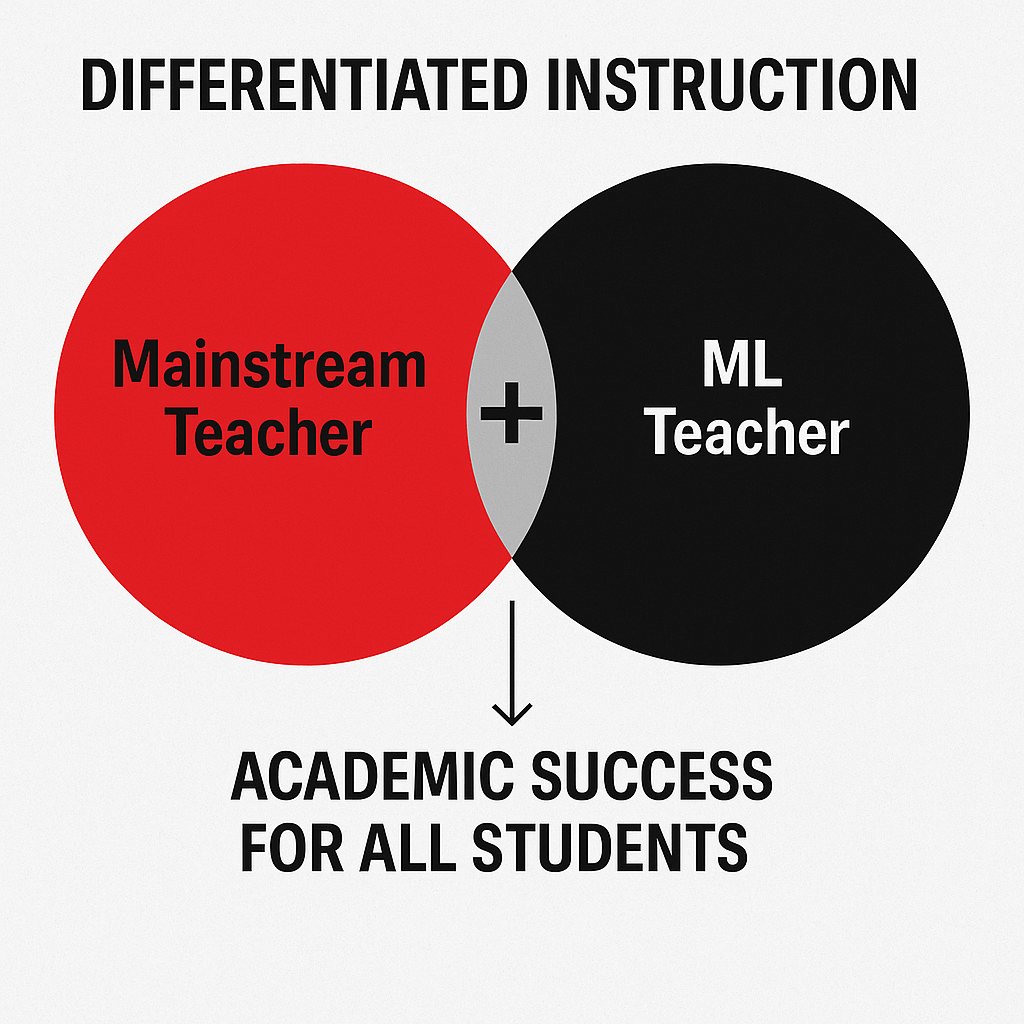
Some ways we differentiate instruction in the classroom for our Multilingual Learners (MLs) include the use of sentence frames to support academic language development and help students express their ideas in complete, structured responses. We also incorporate visual aids, graphic organizers, and anchor charts to make abstract concepts more concrete and accessible. Pre-teaching and reinforcing academic vocabulary allows MLs to participate more confidently in classroom discussions. Additionally, we utilize small-group instruction, peer collaboration, and hands-on activities to offer multiple entry points for learning. Providing language objectives alongside content objectives, modeling academic discourse, and allowing extra processing time ensure that students can engage meaningfully with grade-level material. All these practices reflect our shared commitment—both content area teachers and ML teachers—to create an inclusive environment where every student can achieve academic success.
Differentiation requires effort, time, and sacrifice—but every small step counts. It should become a daily routine, an intentional practice that opens doors to equity. As educators, we must interact with MLs even when they are still developing their language. Each conversation, each visual aid, each scaffold brings them closer to confidence and academic success. As the saying goes, after every sacrifice comes growth. The fruits of differentiated instruction are seen in the smiles, voices, and progress of our multilingual learners—students who, with the right support, learn not only English but the power of perseverance.
 Build your English with Ms. Mirla