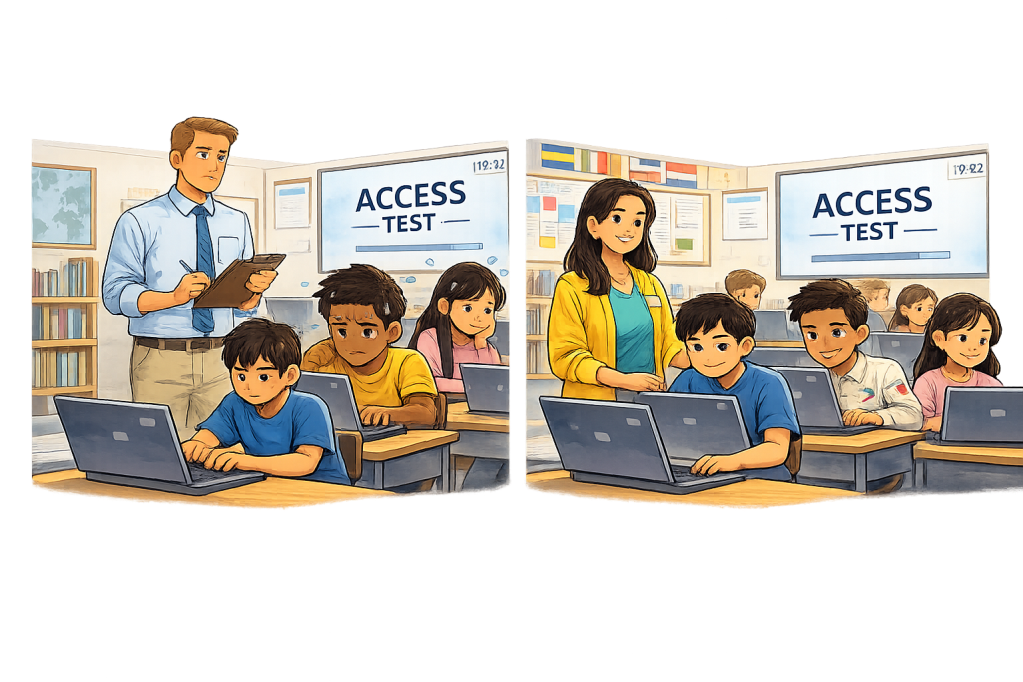
A Reflection on Trust, Equity, and Student Performance
In schools across the country, language proficiency assessments are administered during designated testing windows to measure the academic English growth of multilingual learners. These assessments are essential. They inform instruction, guide placement decisions, and reflect students’ linguistic development over time.
Yet, one critical question often goes unexamined:
Who is best suited to administer these assessments?
Language proficiency testing is not simply procedural. It is relational.
Multilingual teachers spend the entire academic year working closely with their students. They understand their language profiles, their academic strengths, their hesitations, their cultural backgrounds, and their emotional needs. They have built trust. They have built confidence. They have built psychological safety.
Research in educational psychology consistently shows that students perform better in environments where they feel secure and supported. For multilingual learners—who are asked to read, write, speak, and listen in a language they are still developing—the testing environment can significantly influence performance.
When students take assessments with the teacher who has guided them throughout the year, there is familiarity. There is reassurance. There is confidence.
When assessments are administered by teachers outside of the multilingual program, even highly capable and collaborative content-area teachers, the experience may feel very different. Content teachers are experts in their disciplines, and their support is valuable. However, they are not specialists in second language acquisition, nor do they always share the same relational connection with multilingual learners.
This distinction is not about hierarchy. It is about specialization and student-centered practice.
Students have expressed feeling less confident, more anxious, or more inhibited when tested by adults they do not know well. For many multilingual learners—particularly those from cultures where relational trust and familiarity are deeply valued—the presence of a trusted educator reduces fear and increases risk-taking in language production.
A testing environment led by someone unfamiliar may unintentionally result in:
- Increased anxiety
- Hesitation during speaking tasks
- Reduced participation
- Lower confidence in writing responses
- Emotional withdrawal
Language proficiency assessments require vulnerability. Students are asked to produce language publicly, often under timed conditions. Confidence directly impacts output.
Trust reduces fear. Familiarity increases performance.
If schools dedicate intentional planning, urgency, and collective focus to end-of-grade exams and accountability measures, then language proficiency assessments deserve the same level of intentional care. These assessments determine services, instructional support, and long-term academic pathways for multilingual learners.
That is not about convenience. It is about equity.
A Call to Educational Leaders
As schools continue striving toward inclusive and equitable practices, it may be worth reflecting on how language proficiency assessments are administered.
Are we creating the most supportive environment possible for multilingual learners?
Are we honoring the expertise of multilingual educators?
Are we ensuring that testing conditions allow students to demonstrate their true linguistic abilities?
Intentional decisions about administration are small shifts that can produce meaningful impact.
When we protect trust, we protect performance.
When we honor specialization, we honor students.
And when we value multilingual learners fully, we demonstrate that equity is not just a word — it is a practice.
Ms. Mirla Rodriguez, M.A. TESOL
Multilingual Educator and Language Specialist
 Build your English with Ms. Mirla