The Importance of Differentiated Instruction for Multilingual Learners

By: Ms. Mirla Rodriguez

Learning a second language is a challenge that many of us have experienced—sometimes voluntarily, because of the profession we chose. In my case, I wanted to become an ESL teacher. I learned English with passion and love. However, many of our Multilingual Learners (MLs) must learn it out of necessity, not by choice. They did not choose to move to a new country or to be placed in a classroom where the language of instruction is unfamiliar.

When you must learn something because there is no other option, the process becomes more difficult—especially in the academic setting. Fortunately, thanks to differentiated instruction, children and teens can overcome this challenge and find success both linguistically and academically.

What Is Differentiated Instruction?

Differentiation is equitable instruction that makes learning accessible for all students. Dr. Carol Ann Tomlinson, a leading voice in the field, defines it as ‘shaking up what goes on in the classroom so that students have multiple options for taking in information, making sense of ideas, and expressing what they have learned.’ One of Tomlinson’s undergraduate students once defined differentiation as ‘a sequence of common-sense decisions made by teachers with a student-first orientation.’

This means that differentiation is not about creating different lessons for each student—it’s about making thoughtful adjustments that respond to diverse learning needs.

For example, differentiation happens when:

  • You notice a student struggling to read from the back of the room and move them closer to the board.
  • You introduce visuals, gestures, or examples to help a student grasp new vocabulary.
  • You provide enrichment tasks to students who finish early.
  • You strategically pair a newcomer English learner with a bilingual peer who can translate or clarify key ideas.
  • You incorporate a student’s personal interests into your examples or practice tasks to make learning meaningful.

Why Content Area Teachers Must Differentiate

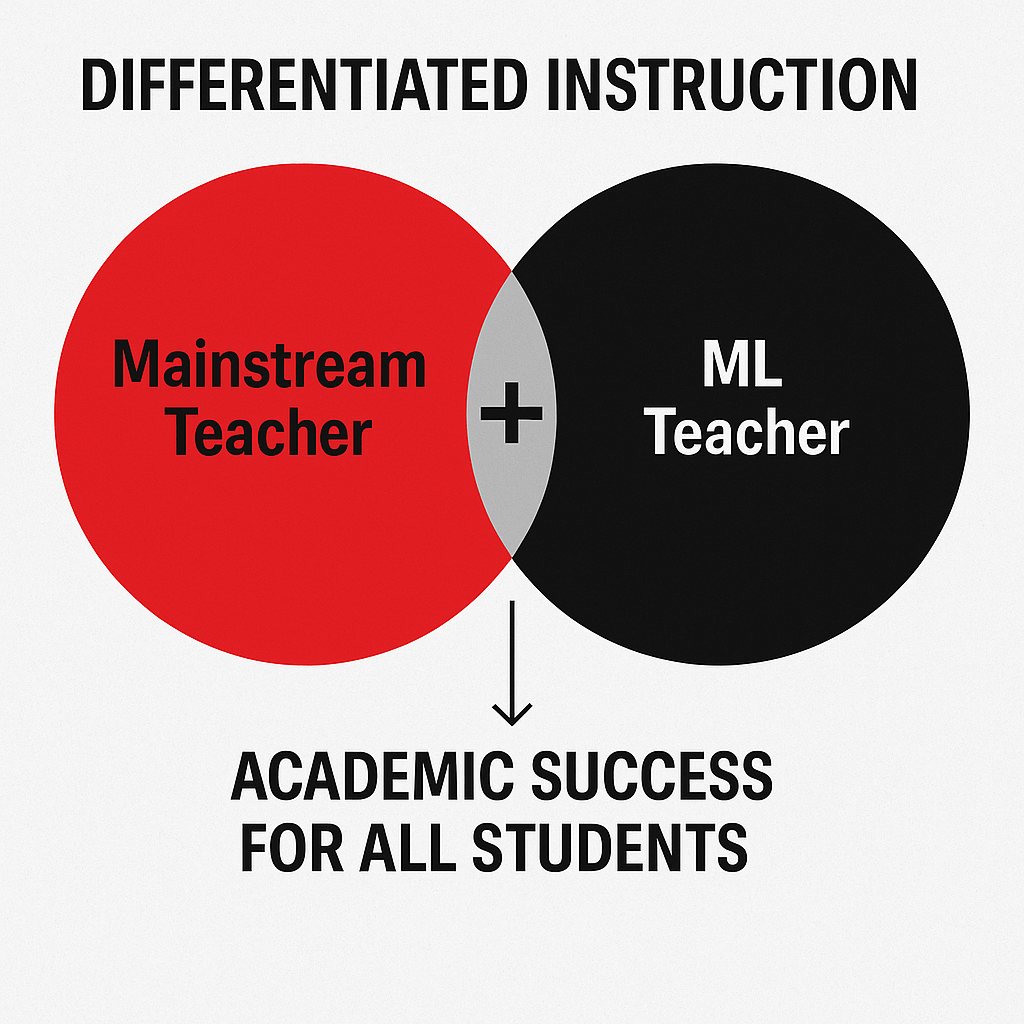
Differentiated instruction benefits all students, not only MLs. When teachers understand their students’ strengths, weaknesses, and interests, they can intentionally design instruction that reaches every learner. For MLs in particular, differentiation is crucial in developing the language skills required for academic success.

Content area teachers play a key role in this process. Language development cannot happen in isolation—it must occur within the context of content learning. Every math, science, social studies, and ELA teacher is also a language teacher, whether they realize it or not. Differentiation allows MLs to access rigorous content while building vocabulary, grammar, and communication skills simultaneously.

However, differentiation must begin the moment we know we have MLs in our classrooms. Too often, teachers differentiate only during assessments but not during the lessons themselves. If a student is never given the chance to say, ‘I don’t understand,’ how can we fairly assess what they know?

Some ways we differentiate instruction in the classroom for our Multilingual Learners (MLs) include the use of sentence frames to support academic language development and help students express their ideas in complete, structured responses. We also incorporate visual aids, graphic organizers, and anchor charts to make abstract concepts more concrete and accessible. Pre-teaching and reinforcing academic vocabulary allows MLs to participate more confidently in classroom discussions. Additionally, we utilize small-group instructionpeer collaboration, and hands-on activities to offer multiple entry points for learning. Providing language objectives alongside content objectives, modeling academic discourse, and allowing extra processing time ensure that students can engage meaningfully with grade-level material. All these practices reflect our shared commitment—both content area teachers and ML teachers—to create an inclusive environment where every student can achieve academic success.

Differentiation requires effort, time, and sacrifice—but every small step counts. It should become a daily routine, an intentional practice that opens doors to equity. As educators, we must interact with MLs even when they are still developing their language. Each conversation, each visual aid, each scaffold brings them closer to confidence and academic success. As the saying goes, after every sacrifice comes growth. The fruits of differentiated instruction are seen in the smiles, voices, and progress of our multilingual learners—students who, with the right support, learn not only English but the power of perseverance.

Reflecting on ACCESS Test Scores and WIDA: A Deeper Dive

By: Mirla Rodriguez

After encountering numerous concerns from fellow multilingual learners (ML) teachers about ACCESS test scores and the WIDA framework, I initially dismissed my own apprehensions as mere personal biases against the system. However, connecting with ML educators across various states through social media prompted a more thorough investigation into the true nature and impact of ACCESS tests.

This article stems from that research and is designed to raise thoughtful questions for readers to consider. By delving into these issues, I hope to foster a deeper understanding and reflection on the challenges and implications surrounding ACCESS testing.

In a recent examination of the ACCESS test scores and their application in decision-making, several issues have been highlighted by educators. Carolyn N. Waters, Ph.D., in her work “Policy and Practice Brief 6: Considerations for Using ACCESS Test Scores in Decision-Making,” brings attention to these concerns based on a survey conducted shortly after the 2019 Virginia state ACCESS testing period.

The survey of 273 K-12 English Learner educators in Virginia highlighted several potential threats to the validity of the ACCESS test, with reliability being a key concern. Reliability, or the consistency of scores across different settings, was questioned due to issues such as score discrepancies between paper and electronic test versions, inadequate and noisy testing environments, and inconsistent test preparation practices. The latter varied significantly, with some schools offering no preparation, while others provided targeted or extensive preparation using materials from teachers or WIDA, the organization behind the ACCESS test. These factors collectively threaten the test’s reliability and validity, raising concerns about its effectiveness in educational decision-making.

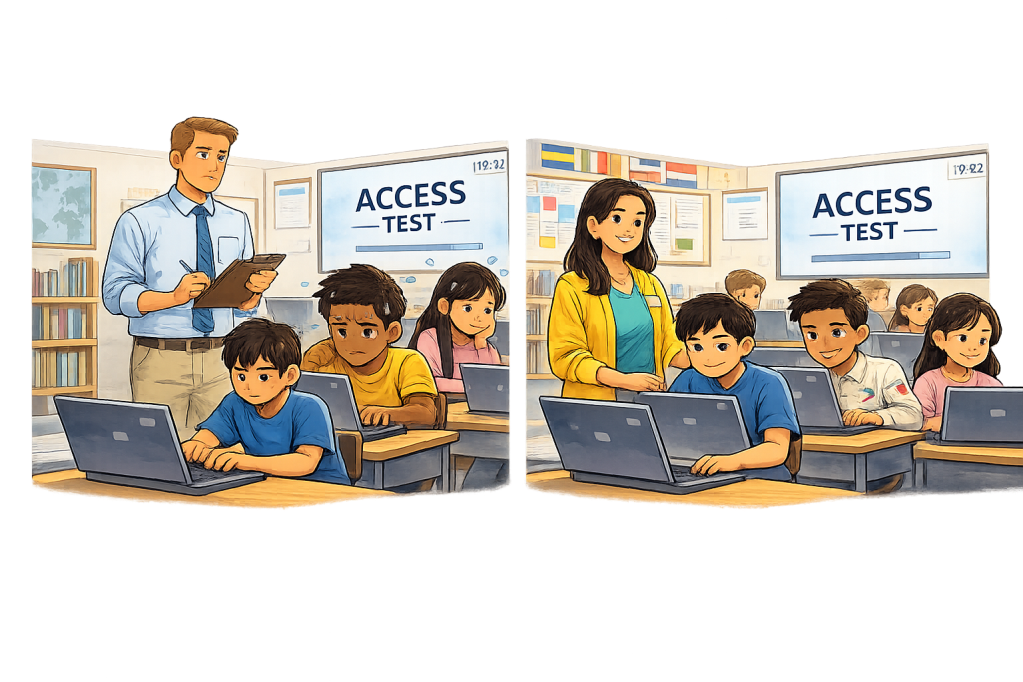
In an insightful article titled “8 Reasons Not to Take Student WIDA ACCESS Scores Too Seriously” by Madeleine Clays (2024), the author outlines several reasons to approach these scores with caution. Here are the key points she highlights:

  1. Unfamiliar Test Administrators: Students are often assessed by strangers, which can affect their comfort levels and performance.
  2. Unfamiliar Testing Environments: The WIDA ACCESS assessments frequently take place in unfamiliar settings, which can be unsettling for students.
  3. Distractions During Testing: There are often numerous distractions present during the testing period, which can hinder students’ ability to focus.
  4. Mid-Year Timing: The assessment is conducted halfway through the school year, which may not reflect students’ true progress.
  5. Post-Holiday Testing: Testing typically occurs right after a two-week break, when students might not be fully re-engaged with their school routine.
  6. Limited Computer Experience: Many English learners have limited experience with computers, which can affect their test performance.
  7. Competing School Events: Other events at school can compete for students’ attention, making it difficult for them to concentrate on the test.
  8. General Test Anxiety: Many students do not perform well in test scenarios, which can lead to scores that do not accurately represent their abilities.

These points suggest that while WIDA ACCESS scores can provide some insights, they should not be the sole measure of a student’s language proficiency or academic potential.

District departments responsible for the English language should actively communicate with school leaders and English language educators to tackle these challenges and to guarantee that the conditions for WIDA ACCESS testing are sufficient. This will help prepare students for a successful testing experience.

Educators and parents must express their concerns and support students to perform optimally on this assessment, ensuring that their scores more accurately represent their proficiency in the four language domains

In the article “Are WIDA Test Results Appropriately Reflecting Multilingual Learners’ Language Skills According to ESOL Teachers’ Experiences? Results of a Pilot Study,” published in the GATESOL Journal 2024 by Emily Patterson and Elke Schneider from the Richard W. Riley College of Education at Winthrop University, the authors explore the effectiveness of WIDA ACCESS testing. This study contributes to the limited research surrounding WIDA ACCESS assessments. While studies affiliated with WIDA suggest that these tests are beneficial for making decisions based on standardized testing data, teaching strategies, and teacher evaluations, our independent research highlights several issues with WIDA ACCESS’s effectiveness. These findings align with those of Coulter (2017), Waters (2020), and Lopez and Garcia (2020), who emphasize the necessity for better standardized language proficiency assessments to address the gap between actual and perceived language skills of multilingual learners.

Despite these concerns, WIDA ACCESS tests remain the primary tool for assessing language proficiency in multilingual learners. There is a need for further research to evaluate the authenticity of WIDA ACCESS testing from the viewpoint of ESOL teachers. Expanding on our small-scale study, future research should incorporate diverse geographic, socioeconomic, and cultural perspectives, with broader participation from early childhood through high school ESOL experiences, and include voices from rural, suburban, and urban educational settings. Additionally, comparing WIDA testing practices and student exit rates with those of other standardized language tests used in states not employing WIDA ACCESS could provide valuable insights. Overall, the findings from this study have the potential to enhance ESOL education and assessment, benefiting both the ESOL field and the wider educational community.

This blog was created to inspire and motivate ML (Multilingual Learner) teachers to delve deeper into researching the ACCESS test and WIDA. Numerous case studies can help amplify our voices and aid schools in comprehending what lies behind this annual test. It is important to move away from placing blame on teachers for the fact that “students do not exit the ESL program.” The situation is much more complex than it appears.

By understanding these assessments better, we can work together to create more informed educational strategies that truly support our students’ diverse needs.

References

https://owlcation.com/academia/8-Reasons-WIDA-ACCESS-Student-Scores-May-Be-Invalid


Navigating Transitions in ESL Teaching Approaches

Switching from one teaching approach to another in the realm of English as a Second Language (ESL) requires discernment and a thorough analysis of the existing approach. As an ESL teacher, the concern is palpable when schools or districts decide to change their methodologies, akin to swapping seats mid-journey. This transition can be particularly challenging for ESL educators who may not be familiar with each language teaching approach in practice. It is essential to acknowledge teachers’ expertise in these transitions, as professional development and training are crucial for implementing any new approach effectively.

Importance of Teacher Involvement

The previous teaching approach in place should undergo a detailed analysis, with ESL teachers being the most appropriate individuals to explain its effectiveness. A significant mistake often made is implementing a new approach under unsuitable conditions, much like wearing ill-fitting clothes. After perusing numerous testimonies from different school districts, many ESL teachers express their frustrations regarding these transitions. Here are several reflective questions:

  1. What guidelines or steps does the school or district follow to make decisions about changing approaches?
  2. Were ESL teachers considered in the decision-making process regarding the change in teaching approaches?
  3. Do ESL teachers have the opportunity to express their input or opinions about their experiences and thoughts on how to best serve ESL students?

Frustrations Faced by ESL Teachers

The frustrations experienced by ESL teachers during sudden transitions often stem from a lack of consultation and consideration. When their insights and experiences are overlooked, it can lead to several challenges:

  • Loss of Autonomy: Teachers feel disempowered when they are not part of the decision-making process. Their expertise and firsthand experiences are invaluable resources that go untapped.
  • Inadequate Training: Without proper training and professional development, teachers may struggle to adapt to new methodologies, impacting their effectiveness in the classroom.
  • Disruption of Established Practices: Sudden changes can disrupt established routines and practices that have proven effective in aiding language acquisition for ESL students.
  • Increased Stress and Burnout: The pressure to quickly adapt to new approaches without sufficient support can lead to increased stress and burnout among teachers.

Moving Forward

To ensure successful transitions in teaching approaches, it is crucial to involve ESL teachers from the outset. Their participation can provide valuable insights and foster a sense of ownership and commitment to the new approach. Schools and districts should prioritize:

  • Collaborative Decision-Making: Engage ESL teachers in discussions and decisions regarding new teaching methodologies.
  • Comprehensive Training Programs: Offer robust professional development opportunities to equip teachers with the skills needed for new approaches.
  • Feedback Mechanisms: Create avenues for teachers to share their experiences and feedback, ensuring continuous improvement and adaptation.

By valuing the contributions of ESL teachers and addressing their frustrations, schools and districts can create a more supportive environment that enhances the educational experience for both teachers and students.

Valuing Multilingual Learner (ML) Teachers: Essential Contributors to Education

Multilingual Learner (ML) teachers are specialized professionals dedicated to teaching English to speakers of other languages. Many school districts employ these individuals due to the increasing number of multilingual learners. Despite their invaluable contribution, their efforts often go unnoticed in schools.

ML teachers are frequently overlooked and sometimes reduced to roles as translators or interpreters, rather than being integrated into the educational team. This marginalization is a significant oversight, as the expertise of these teachers is crucial for enhancing academic outcomes.

The perception that content area subjects are more academically significant than English language instruction is a misjudgment. Recognizing ML teachers as essential resources could lead to improved educational achievements across schools. Every individual involved in a child’s education, especially those with specialized degrees, plays a vital role in shaping a child’s academic journey, a fact that some schools seem to have forgotten.

Conversations with many ML teachers reveal experiences suggesting a form of marginalization. This oversight not only undermines the teachers’ contributions but also affects the academic progress of the students they support. It is imperative for schools to acknowledge and integrate the expertise of ML teachers to foster a more inclusive and effective educational environment.

An ML teacher is a professional, just like any other educator. They have pursued studies at the university level and have obtained certification by passing the required state exams, such as the Praxis test. ML teachers possess the necessary skills, strategies, and techniques to teach English to multilingual learners. Underestimating their potential and professionalism is a significant mistake because they are a crucial component in the academic success of multilingual learners, who represent one of the largest populations in many schools.

It is essential for schools to start seeing these individuals as an integral part of their school community by providing them with opportunities to share, collaborate, and work as part of a team alongside the rest of the school staff. Consider these reflective questions to assess your engagement with ML teachers:

  1. Do you know the ML teacher in your school?
  2. How often do you collaborate with the ML teacher in planning your classes?
  3. Have you ever sought the ML teacher’s professional advice?
  4. Have you ever missed the ML teacher in your Professional Learning Community (PLC) meetings?

Additional Questions for Reflection

To further encourage schools and staff to reflect on the role of ML teachers, consider the following questions:

  • What specific strategies do you implement to support multilingual learners in your classroom?
  • How do you ensure that the contributions of ML teachers are valued and integrated into your school’s curriculum and culture?
  • In what ways can the school administration support ML teachers in their professional development?
  • How does your school measure the success of its ML program, and what improvements have been made based on these evaluations?
  • What steps can be taken to increase collaboration between ML teachers and other faculty members?

These questions aim to foster a deeper understanding and appreciation of the vital role ML teachers play in enhancing the educational experiences of multilingual learners.

Supporting Multilingual Learners: A Call to Action for Mainstream Teachers

-Mirla Rodriguez-

In today’s increasingly diverse classrooms, the presence of multilingual learners is more common than ever. However, a significant challenge remains: many mainstream teachers lack the knowledge and skills required to effectively support these students. While this is a recognized issue, it should not deter educators from making a genuine effort to assist their multilingual learners.

Do You Need to Speak Their Language?

One common misconception is that teachers must speak a student’s native language to provide meaningful support. This is simply not the case. Many ESL (English as a Second Language) teachers do not share the same linguistic background as their students, yet this has not hindered their ability to facilitate learning. The key lies in understanding and employing effective teaching strategies that transcend language barriers.

The Importance of Training

While it is ideal for teachers to receive formal training in working with English Language Learners (ELLs), the absence of such training should not be a roadblock. It becomes crucial for mainstream teachers to collaborate closely with ELL specialists. These specialists are invaluable resources, offering tips, strategies, and techniques uniquely tailored to support multilingual learners. They are, in essence, a lifeline for teachers navigating the complexities of a diverse classroom.

Embracing Accommodations and Scaffolding

To effectively support multilingual learners, mainstream teachers must familiarize themselves with various accommodations that can be integrated into their classrooms. Understanding how to scaffold activities and topics is essential. This means breaking down lessons into manageable parts and providing support at each stage, allowing ELLs to build their understanding gradually.

A Commitment to Inclusion

Above all, teachers must commit to consistently supporting multilingual learners. Ignoring their needs is not an option. By actively engaging with ELL specialists and embracing inclusive teaching practices, educators can create a learning environment where all students have the opportunity to succeed.

In conclusion, while challenges exist, mainstream teachers have the power and responsibility to ensure that multilingual learners receive the support they need. By leveraging resources, collaborating with specialists, and embracing inclusive strategies, educators can make a significant impact on the educational experiences of their multilingual students. Let us rise to the occasion and commit to making a difference.

Apoyando a los Estudiantes Multilingües: Un Llamado a la Acción para los Maestros de Aula Regular

En las aulas cada vez más diversas de hoy en día, la presencia de estudiantes multilingües es más común que nunca. Sin embargo, persiste un desafío significativo: muchos maestros de aula regular carecen del conocimiento y las habilidades necesarias para apoyar efectivamente a estos estudiantes. Aunque este es un problema reconocido, no debería disuadir a los educadores de hacer un esfuerzo genuino para ayudar a sus estudiantes multilingües.

¿Necesita en maestro hablar el idioma del estudiante multilingue?

Un concepto erróneo común es que los maestros deben hablar el idioma nativo de un estudiante para brindar un apoyo significativo. Esto simplemente no es el caso. Muchos maestros de ESL (Inglés como Segundo Idioma) no comparten el mismo trasfondo lingüístico que sus estudiantes, sin embargo, esto no ha impedido su capacidad para facilitar el aprendizaje. La clave radica en comprender y emplear estrategias de enseñanza efectivas que trascienden las barreras del idioma.

La Importancia de la Capacitación

Si bien es ideal que los maestros reciban capacitación formal para trabajar con Estudiantes del Idioma Inglés (ELLs), la ausencia de dicha capacitación no debería ser un obstáculo. Es crucial que los maestros de aula regular colaboren estrechamente con especialistas en ELL. Estos especialistas son recursos invaluables, ofreciendo consejos, estrategias y técnicas exclusivamente diseñadas para apoyar a los estudiantes multilingües. En esencia, son un salvavidas para los maestros que navegan por las complejidades de un aula diversa.

Adoptando Acomodaciones y Estrategia de Desglosaje

Para apoyar efectivamente a los estudiantes multilingües, los maestros de aula regular deben familiarizarse con varias acomodaciones que se pueden integrar en sus aulas. Comprender cómo desglosar las actividades y temas es esencial. Esto significa dividir las lecciones en partes manejables y proporcionar apoyo en cada etapa, permitiendo que los ELLs construyan su comprensión de manera gradual.

Un Compromiso con la Inclusión

Sobre todo, los maestros deben comprometerse a apoyar consistentemente a los estudiantes multilingües. Ignorar sus necesidades no es una opción. Al interactuar activamente con especialistas en ELL y adoptar prácticas de enseñanza inclusivas, los educadores pueden crear un entorno de aprendizaje donde todos los estudiantes tengan la oportunidad de tener éxito.

En conclusión, aunque existen desafíos, los maestros de aula regular tienen el poder y la responsabilidad de asegurar que los estudiantes multilingües reciban el apoyo que necesitan. Al aprovechar los recursos, colaborar con especialistas y adoptar estrategias inclusivas, los educadores pueden tener un impacto significativo en las experiencias educativas de sus estudiantes multilingües. Levantémonos ante la ocasión y comprometámonos a marcar la diferencia.

Navigating New Horizons: Challenges of ESL Students in American Schools

-Mirla Rodriguez-

As an ESL teacher, I’ve witnessed firsthand the challenges faced by children who come to the United States not by choice, but by circumstance. These young learners are thrust into American schools without any knowledge of the English language, and often, they find themselves navigating this new world in silence.

Initially, these children are typically assigned a “buddy” to help them through their days. Despite this support, they often remain quiet, taking in their surroundings with wide eyes. Everything is unfamiliar—the school buildings, the teachers, the classmates. They are in a state of shock, missing their home country, friends, and relatives.

As time passes, the child begins to learn a few words and finds the courage to attempt communication. However, the struggle is far from over. Misunderstandings abound, classmates may laugh, and occasionally, teachers lose patience. The “buddy” becomes a crucial link, explaining the teacher’s words to the child. The teacher, frustrated by the language barrier, may excuse themselves, saying they don’t speak Spanish, yet often fail to seek effective ways to support the child.

The child receives limited ESL instruction, sometimes benefiting from accurate translations, but often left in confusion. With low grades and guesses on computerized tests, they are lost in the academic shuffle, grappling to comprehend each class.

As the end of the school year approaches, the teacher contacts the child’s parents, suggesting retention due to the child’s lagging performance. The parents, bewildered, recall that their child excelled academically in their native country. The teacher insists their child is behind, prompting several questions in my mind.

  • Is the classroom teacher actively working on developing this child’s language proficiency?
  • Are activities scaffolded to aid understanding?
  • Is there collaboration between the classroom and ESL teachers to support this child?
  • What steps is the ESL teacher taking to bridge language gaps?
  • Is there regular communication between the ESL specialist and the grade-level teacher regarding the child’s academic progress?
  • Why wait until the end of the year to consider retention when early intervention could have made a difference?

These questions reflect the ongoing struggle and point to the need for a more inclusive and supportive educational environment. This story, much like these children’s journey, is far from over.

Desafíos de los Niños Inmigrantes en las Escuelas de EE.UU.

Como Profesora de inglés como segunda lengua, he sido testigo de los desafíos que enfrentan los niños que llegan a los Estados Unidos no por elección, sino por circunstancias. Estos jóvenes estudiantes son lanzados a las escuelas americanas sin ningún conocimiento del idioma inglés y, a menudo, se encuentran navegando en este nuevo mundo en silencio.

La Experiencia Inicial

Inicialmente, a estos niños se les asigna típicamente un “compañero” para ayudarles en sus días. A pesar de este apoyo, a menudo permanecen callados, observando su entorno con los ojos bien abiertos. Todo es desconocido: los edificios escolares, los maestros, los compañeros de clase. Están en estado de shock, extrañando su país de origen, amigos y familiares.

Progreso y Desafíos Continuos

Con el tiempo, el niño comienza a aprender algunas palabras y encuentra el valor para intentar comunicarse. Sin embargo, la lucha está lejos de terminar. Las malinterpretaciones abundan, los compañeros de clase pueden reírse y, ocasionalmente, los maestros pierden la paciencia. El “compañero” se convierte en un vínculo crucial, explicando las palabras del maestro al niño. El maestro, frustrado por la barrera del idioma, puede excusarse, diciendo que no habla español, pero a menudo no busca formas efectivas de apoyar al niño.

El niño recibe instrucción limitada de ESL (Inglés como Segundo Idioma), a veces beneficiándose de traducciones precisas, pero a menudo quedando en la confusión. Con bajas calificaciones y adivinanzas en pruebas computarizadas, se pierden en la confusión académica, luchando por comprender cada clase.

Consideraciones para la Retención

A medida que se acerca el final del año escolar, el maestro contacta a los padres del niño, sugiriendo la retención debido al rendimiento rezagado del niño. Los padres, desconcertados, recuerdan que su hijo sobresalía académicamente en su país de origen. El maestro insiste en que su hijo está atrasado, lo que provoca varias preguntas en mi mente.

  • ¿Está el maestro de aula trabajando activamente en desarrollar la competencia lingüística de este niño?
  • ¿Están las actividades estructuradas para facilitar la comprensión?
  • ¿Existe colaboración entre los maestros de aula y los de ESL para apoyar a este niño?
  • ¿Qué pasos está tomando el maestro de ESL para cerrar las brechas lingüísticas?
  • ¿Hay comunicación regular entre el especialista de ESL y el maestro del grado sobre el progreso académico del niño?
  • ¿Por qué esperar hasta el final del año para considerar la retención cuando una intervención temprana podría haber hecho la diferencia?

Estas preguntas reflejan la lucha continua y señalan la necesidad de un entorno educativo más inclusivo y de apoyo. Esta historia, al igual que el viaje de estos niños, está lejos de terminar.